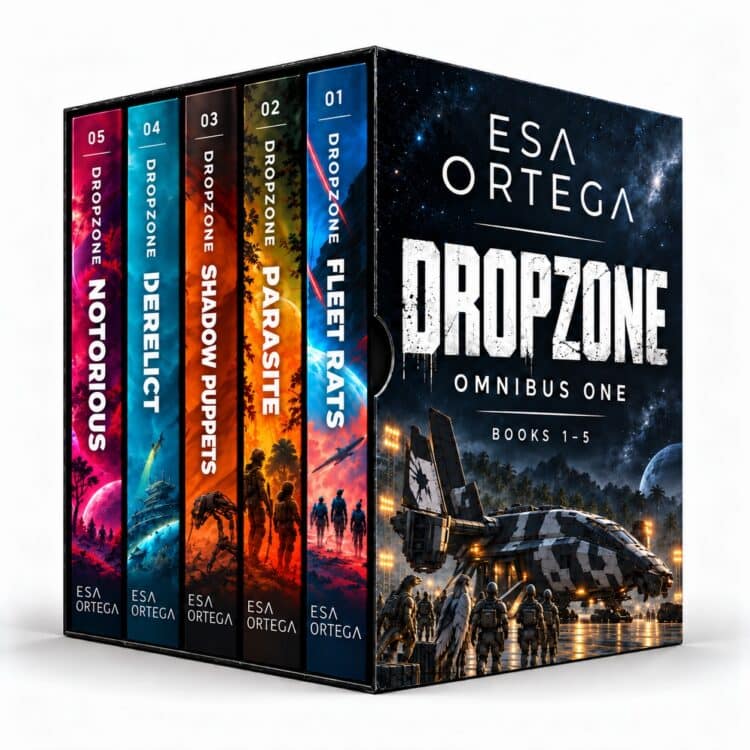
The Dropzone Omnibus One and Two box sets are out now – here are some thoughts on four years of writing a series and keeping the friction in the fiction in the age of AI.
With the Dropzone books now collected together into two Dropzone Omnibus releases, now seems a good time to look back. Here are some thoughts on why I decided to write the series in the first place, how it changed while I was writing it, what I hope readers get from it and what it means to spend years making this sort of hobbyist science fiction at a time when the business of creating fiction is transforming quicker than the polymorph in Red Dwarf.
Let’s start with: why the drek did you write a 10-book series if you don’t make any money out of them?
Good question. To clarify, I don’t currently make a profit out of writing books and this is the 15th I’ve written so far. It’s purely a hobby, something I do in my spare time between working and life admin. I began writing military sci-fi books during lockdown and then just carried on; I was able to devote a bit more time to doing it when I was a freelance writer and when I went travelling for a year or so, but nowadays I fit plotting, writing, editing, marketing and the rest in between full-time work.
I’ll rephrase: so why the drek did you write a 10-book series if you don’t have much time to write them?
I didn’t think it’d take as long as it did. Also, why not?
I’d already written the two books in the Kassini series, which are space operas with denser worldbuilding, more in-depth lore and heavier themes such as politics, galactic empires, First Contact and robotic existentialism woven together in them. I’d also written a couple of standalone books, but I asked myself what I really wanted to write next as a longer-term project.
The answer at the time, in 2022, was a series of prequels to the Kassini space-opera series, set in the same universe, which followed a group of reluctant soldiers earning their freedom across 10 missions. I deliberately limited the books to 10 chapters each and the idea was to mimic the episodic nature of a streaming TV series: so the underlying format would reset each time – same squad, same predicament, another mission – while the characters and the consequences carried on from one book to the next.
Why opt for the scenario that you did?
One of the key things about Esa Ortega books is that they pay homage to classic sci-fi stories from books, TV, film and games I’d loved in the past. I had a lot of ideas which, if I’d tried to incorporate them into the space-opera format, would’ve felt like I was crowbarring them in; but if I’d written them as short stories, I wouldn’t have been able to explore them sufficiently.
This is why the Dropzone books all have a fairly familiar mainstream sci-fi precursor somewhere in their DNA, be that Body Snatchers, Aliens, Predator, Enigma Force, Paradroid, Elite… if you’re really interested in finding out more about this aspect of the books, have a look at my blogs, which explain the influences indirectly feeding into each book in more detail.
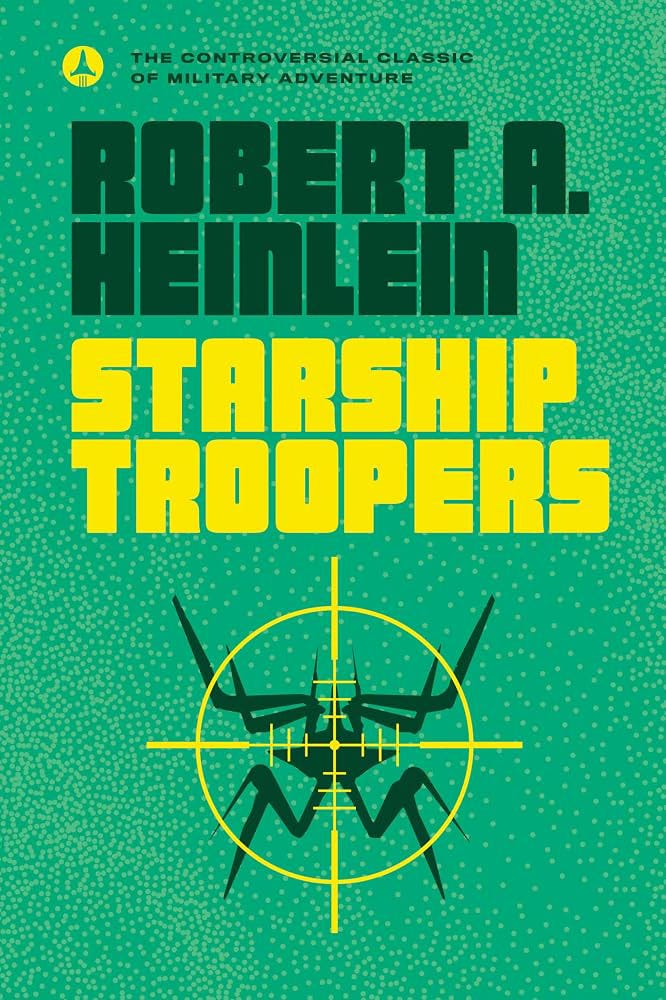
Military sci-fi’s Queen Bug
Even the scenario itself is an amalgamation of classic sci-fi stuff: the in-this-together dropship-trooper feel of Starship Troopers and Aliens repeated in almost all military sci-fi since those two; the Band Of Brothers camaraderie found in Scalzi’s Old Man’s War series; the character development over time of the crew in the Battlestar Galactica remake; and the idea of competing species fighting side-by-side in an uneasy truce familiar from the likes of Star Trek, Mass Effect and Babylon 5.
However, unlike typical space-opera scenarios, I wanted the backdrop of wider intergalactic war to be something the squad and reader dipped in and out of fleetingly. The Dropzone books deliberately zoom in on the squad dynamics and the claustrophobic feel of having to jump into a dropship and go again on another dangerous mission. Contact with current affairs and the outside universe remains deliberately vetted and restricted by the Agency, so they keep their eye organs on the prize.
Hopefully, this creates an opportunity for the reader to bond closely with the characters as the missions roll on and to empathise with the inescapability of their predicament.
Unlike many writers of military sci-fi, I’m not a retired army veteran, so I’m not able to create realism by relying on my own experience of combat scenarios. Instead, I’m trying to address some of the same territory from a different direction: how science fiction can tackle the themes of future warfare, the fascinating subject of the ‘universal soldier’, and how military science-fiction can be used as a way of thinking about the relationship between conflict and society.
What changed over the course of writing 10 books?
I’d originally set myself a condition that I didn’t want to dwell too much on the interior monologues and inner lives of the characters. These are criminals forced to be soldiers in all-action scenarios, after all, and I’m attempting to deliver exciting, thrill-packed, fast-action reads that are breathless, full of twists, turns and jeopardy. For these soldiers, fighting mission after mission, there’s no time to stop and think about what it all means – they’re too busy surviving.
However… after writing a few of them, I realised that this needed to change.
Lovell had originally been conceived as the lodestone, the dependable centre of an increasingly insane situation: an ultimate survivor patched together and sent back into battle to fearlessly lead his troops, a rational and reliable eye of the storm while everyone else freaked out.
The problem was that the longer I kept sending a recognisably normal human being back into completely abnormal situations, the harder it became to pretend those experiences wouldn’t have an effect.
Writing him as a normal person with sane reactions despite his insane predicament meant that I was forced to start addressing the themes affecting him more and more as the series went on.
So as the books progress from one to 10 and the squad dives deeper into the tour of duty, the action definitely stays relentless and intense, but Lovell’s preoccupations gradually change. The books no longer focus only on survival. They begin to ask how soldiers in such high-stress situations manage trauma; how their leaders lead by example; how they reconcile the sometimes questionable morality of their actions; how they support and help each other through unbelievably challenging circumstances; and how they keep coming back for more without totally losing their minds.
It became a much more introspective series than the one I thought I was starting in 2022.
So your attitude to writing your characters changed… what else?
Another thing that’s happened during the relatively brief lifetime of the series is the headlong rise of generative AI and the extent it’s begun to permeate human creativity.
Writing a 10-book series in the gaps between work and life obviously requires a major time investment. When I started Fleet Rats in 2022, I remember thinking that seeing a 10-book series sitting on Amazon meant something fairly unambiguous: somebody had done a hell of a lot of writing. Just four years later, that may not actually be the case.
A recent 2026 working paper, Generative AI floods and dilutes the market for books*, analysed 14,419 self-published genre-fiction eBooks sold on Amazon between 2023 and 2026 – covering much of the period in which I published the series.
The researchers used full-text detection to estimate the proportion of AI-generated prose in each book and compared the results with sales data. Around one in five books in the sample was classified as containing substantial amounts of AI-generated text – more than 25 per cent of the manuscript.
So AI-heavy fiction is clearly no longer a fringe phenomenon, although these books still underperformed their share of the sample in both sales and revenue. What happens when producing enormous quantities of fiction becomes dramatically cheaper, even if each individual book performs less well?
Now, I’m aware that there are full-time sci-fi authors out there who have learned how to maximise their output to the extent that they – and, in some cases, their teams of writers, editors and others – have back catalogues running into hundreds of titles and insane-seeming release schedules of one book per week.
And fair play to them. It’s an impressive achievement.
But generative AI has introduced something fundamentally different into that equation: for the first time, producing large amounts of novel-shaped prose no longer necessarily requires a corresponding amount of human writing time.
Like many authors, for me the gravitational pull to explore what AI can do to speed up – but not replace – the creative process remains powerful.
Using AI as an assistant to help research, brainstorm and discuss story development and to help with advertising, marketing, analysis, imagery and the various other jobs surrounding writing, is roughly where I’ve ended up drawing my own line. Other writers and readers draw that line somewhere completely different. I’ve worked in old-school publishing for decades in the past and collaborating with AI can sometimes mimic the feeling of being part of a roomful of people working together to iterate, brainstorm and make something better.
Amazon itself now makes a similar distinction between AI-generated material and AI-assisted work such as idea-generation, editing and refinement, although that obviously doesn’t settle any of the wider arguments about whether people should be using it in the first place.
Let me be as clear as I can be, though: I don’t see the point in using AI to create the fiction itself. For me, that defeats the point.
Come on, what’s actually wrong with removing the friction from the fiction?
It’s a question of ‘to what extent’. If a machine removes some of the tedious donkey-work around the creative act, I can see the appeal. If it replaces the creative act I sat down to perform, why am I sitting down at all?
That’s where we appear to be heading, though, or at least it’s one possible direction of travel.
Sci-fi authors have spent over a century discussing the impact of technology on society and now the technology is beginning to encroach on the process of creating science fiction itself.
I’m currently contemplating writing another sci-fi series in the Kassini universe. I’m sure I’m not alone among writers at my level in asking myself: is there still a point in committing another four or five years to doing this the slow way, purely for fun, when the economics and cultural expectations surrounding genre fiction are changing so quickly?
This is a different scenario for me than it is for some others, in the sense that I’m not protecting a writing income. There isn’t a do-or-die livelihood for AI to take away. What I’m protecting, if anything, is the reason to bother.
I don’t know what happens to the motivation to spend years learning how to create something flawed, uneven, unpolished and ultimately ‘human’ when a machine can produce something slick, competent and not necessarily recognisably ‘artificial’ in minutes.
Maybe nothing happens. Perhaps people will always want to make things precisely because making them is pleasurable, difficult and occasionally maddening. Finishing 10 of these damn things puts me on that side of the fence.
But will readers in a decade’s time simply push a button for their novels, their films, their series and their music? If so, what will we have lost?
Cripes, calm down. It’s only pulp fiction we’re discussing here. It’s a set of books about people and aliens running around with guns. We won’t have lost a future Booker Prize winner.
Yeah, I know. And we’ll probably all have VR gaming headsets and suits on by then anyway.
I’d just like to think that there are always lessons to be learnt from bygone eras of sci-fi so that when we do have AI-created entertainment on tap, it’ll be able to measure up to the likes of RoboCop, Terminator, Battlestar Galactica and all the other SF I’ve mentioned here – rather than becoming some endless supply of reheated, slick yet strangely unsatisfying versions thereof.
Reheating old science fiction is hardly something you can complain about too loudly. Wasn’t that half the idea behind Dropzone in the first place?
Maybe what we’ll see as AI becomes more pervasive is that we’ll value what happens when those influences pass through an actual person. During the creative process, you misremember things. You combine them clumsily. You develop strange obsessions. Characters refuse to behave as intended. Ideas that seemed important in Book 1 become less interesting, while something you barely noticed becomes central by Book 8. You change your mind.
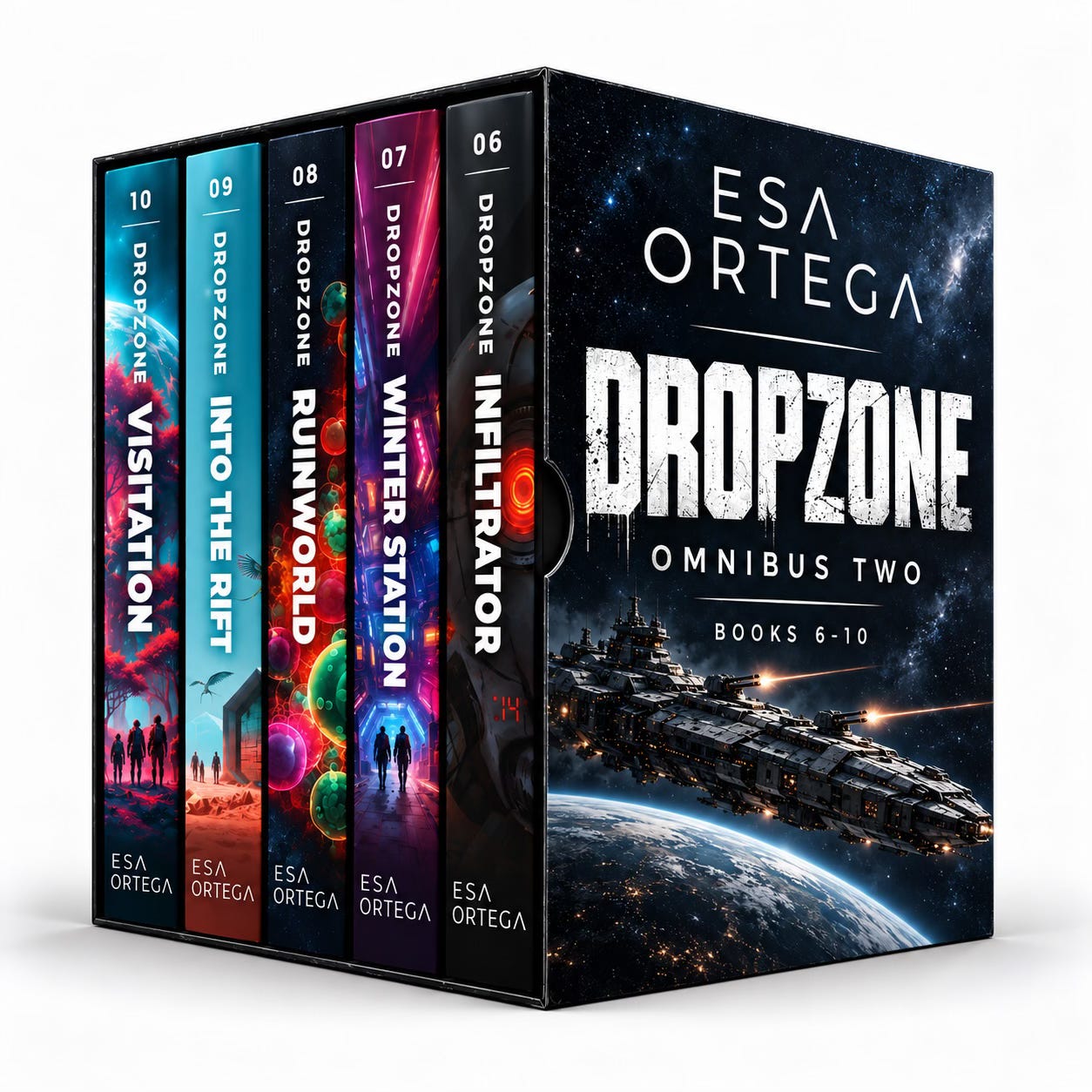
Writing 10 books, the characters become more sophisticated and ask their own questions
I started out intending to write 10 fairly straightforward military-SF adventures about a bunch of reluctant soldiers being dropped into one impossible situation after another. Somewhere along the way, the books became more interested in how those soldiers kept getting back into the dropship, what those repeated death-defying missions were doing to them as a group and whether Lovell could – or even wanted to – remain the same person indefinitely, while everyone around him expected him to keep being the same soldier.
None of that was what I planned when I look back at my original notes from 2022. Maybe that’s the point.
The Dropzone Omnibus editions are available now for £9.99 and £11.99.
Buy Dropzone Omnibus One on Amazon
Buy Dropzone Omnibus Two on Amazon
*Source: Tuhin Chakrabarty, Xinyue Liu, Jane C. Ginsburg and Paramveer Dhillon, ‘Generative AI floods and dilutes the market for books’ (2026 working paper).